Feldera Enterprise Edition
Feldera Enterprise runs Feldera in your own Kubernetes clusters, in the cloud or on-prem, so your data never leaves your perimeter. It is built for teams that run many pipelines in production and need them to be isolated, resilient and secure.
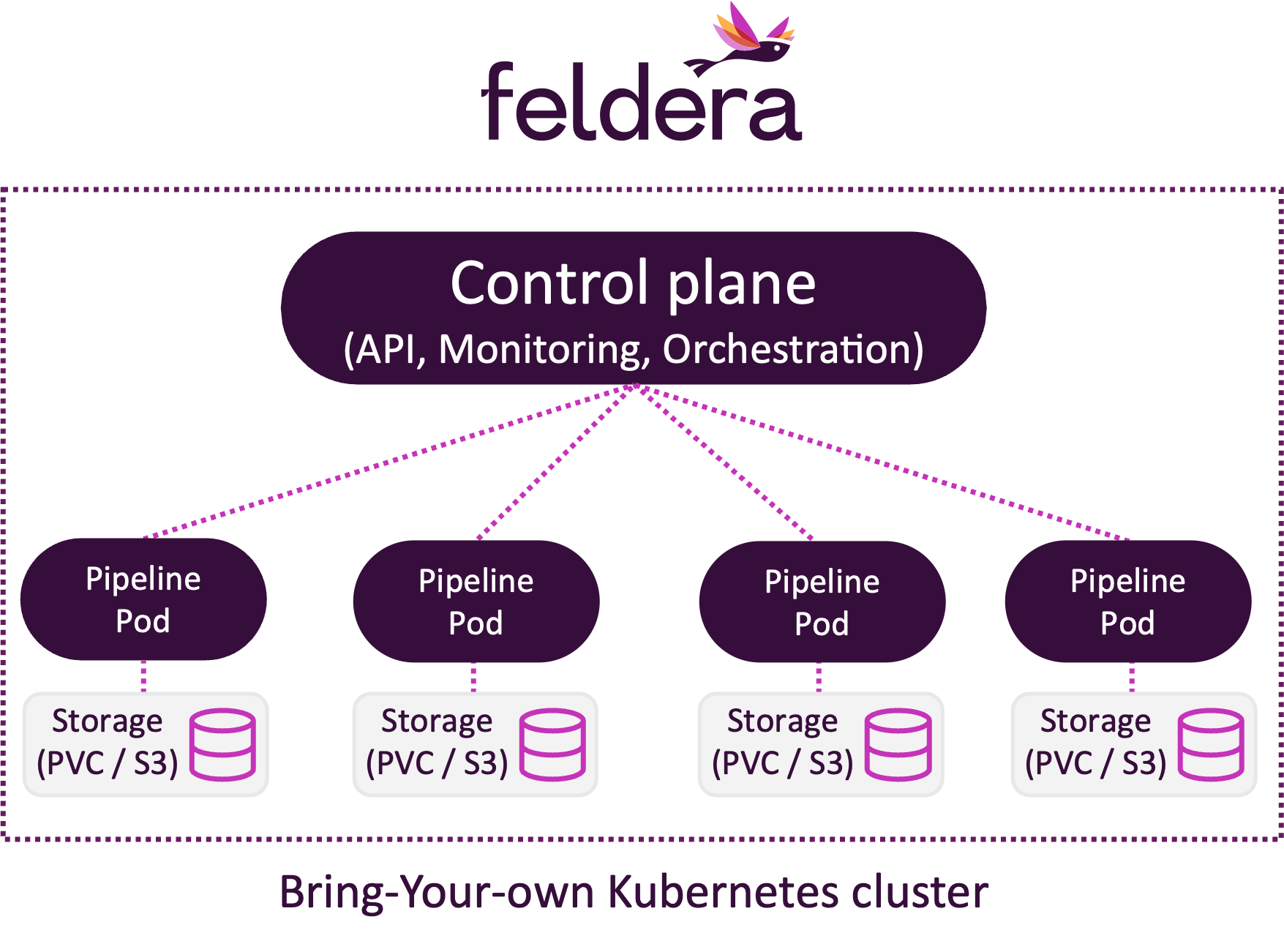
Scale-out across a cluster
All your pipelines can share a cluster of resources. Individual pipelines can also scale out across multiple hosts for intensive backfills. Multi-host pipelines are in preview.
Multi-tenancy
One Feldera Enterprise installation serves many teams. Each team works in its own tenant, and users see and manage only the pipelines in the tenants they are members of. Each membership has a role that sets what the user can do in that tenant. Together with pipeline isolation and per-pipeline resource limits, this lets many teams share one cluster safely.
Pipeline isolation
Each pipeline runs in its own Kubernetes pod, compute- and fault-isolated from other pipelines and from the control plane. Each pipeline can use a Persistent Volume or an S3 bucket for its storage.
Fine-grained resource management
You can set resource reservations and limits for CPU, memory and storage, for the control plane and for each pipeline. When a pipeline uses a Persistent Volume, it can also specify the storage class. These controls help you enforce SLAs and isolate noisy neighbors in shared clusters.
Fault tolerance
Pipelines checkpoint their connector and operator state to a Persistent Volume or to S3. If a node fails or Kubernetes evicts a pipeline pod, Feldera restarts the pipeline automatically, and the pipeline resumes from where it stopped. The control plane also recovers automatically from cluster failures.
S3-backed persistence and backfill
Checkpoint sync copies pipeline state to S3, Google Cloud Storage or Azure Blob Storage. A new pipeline can start from this state on a different node or cluster, and a standby pipeline can take over from it.
When you change a pipeline's SQL, Feldera bootstraps only the views that changed, and keeps the state of all other views. Concurrent bootstrapping (preview) lets the pipeline continue to update its existing views while the new and modified views backfill.
Dynamic resizing
Use different resources for different phases of a pipeline's lifetime. For example, reserve more CPU and memory for the historical backfill, and fewer resources for live traffic in steady state. You can resize a running pipeline (preview) without a restart.
Custom sidecar extensions
Add custom connectors, log shippers or external API clients as a sidecar container next to your pipeline. The sidecar runs in the same pod, and starts and stops with the pipeline.
Metrics and logs
The control plane and the pipelines expose Prometheus-compatible metrics and structured logs. Connect your Feldera cluster to your Prometheus, Grafana or Datadog dashboards without extra agents.
Authentication and access control
Configure single sign-on with Okta, AWS Cognito or any OIDC provider. Use roles in each tenant so that users and teams can see and manage only the pipelines that they are authorized to access.
Least-privilege access
Feldera integrates with Kubernetes Secrets, Service Accounts and IAM Roles for Service Accounts (IRSA). You can run each pipeline with only the permissions it needs.
Compliance
Compliance reports, penetration test results and certifications are available in the Feldera Trust Center.
Support
Enterprise customers get a dedicated Slack channel, support SLAs and forward-deployed engineering. Open source users get help from the Feldera Slack community.
Feldera Enterprise requires a license. Contact us to get one, then follow the installation guide to deploy Feldera into your Kubernetes cluster.