Ad-hoc SQL Queries
You can run ad-hoc SQL queries on a running or paused pipeline. Unlike Feldera SQL programs that define pipelines and are evaluated incrementally, ad-hoc queries are evaluated in batch mode, using the datafusion engine.
Ad-hoc queries provide a way to query the state of materialized tables and views. They are designed to aid development and debugging, so you need to be aware of their limitations to avoid potential confusion.
Limitations
Tables and views are only accessible to SELECT ad-hoc queries if they are declared as materialized.
As of now, there are differences between the SQL dialects of Feldera SQL programs and ad-hoc queries. This is because they use different engines (Apache Calcite for Feldera SQL vs. Apache Datafusion for ad-hoc queries). See below for some examples.
Currently, only SELECT, INSERT, and PREPARE/EXECUTE statements are supported. You cannot create or alter tables and views using ad-hoc SQL.
Differences between Feldera SQL and Ad-hoc Queries
For the common subset of SQL, results should be consistent, aside from minor differences like floating-point rounding or decimal precision handling.
However, there are some known, notable differences in the SQL dialect between Feldera SQL and ad-hoc queries that need to be taken into account:
- The order of output rows is non-deterministic in both dialects without the
ORDER BYclause. - Feldera SQL ignores the outermost order by clause.
- Feldera SQL's
TIMESTAMP_TRUNC(x, MINUTE)isDATE_TRUNC('MINUTE', x)in ad-hoc queries. - Feldera SQL's
SORT_ARRAY()isARRAY_SORT()in ad-hoc queries. - Casting an integer to a timestamp interprets the integer as seconds in ad-hoc SQL and as milliseconds
in Feldera SQL.
(
SELECT 1729595568::TIMESTAMP;will yield2024-10-22T11:12:48in ad-hoc queries and1970-01-21 00:26:35in Feldera SQL). - Ad-hoc SQL cannot perform as-of joins.
- Feldera SQL reads fields of
VARIANTvalues with subscripts (doc['scores'][1], array indexes are 1-based); ad-hoc queries use JSON functions instead (json_get(doc, 'scores', 0), array indexes are 0-based).
We will continue to improve the consistency between the two engines in future releases.
Usage
Ad-hoc queries can be executed via different Feldera tools both when the pipeline is running or paused.
Feldera Web Console
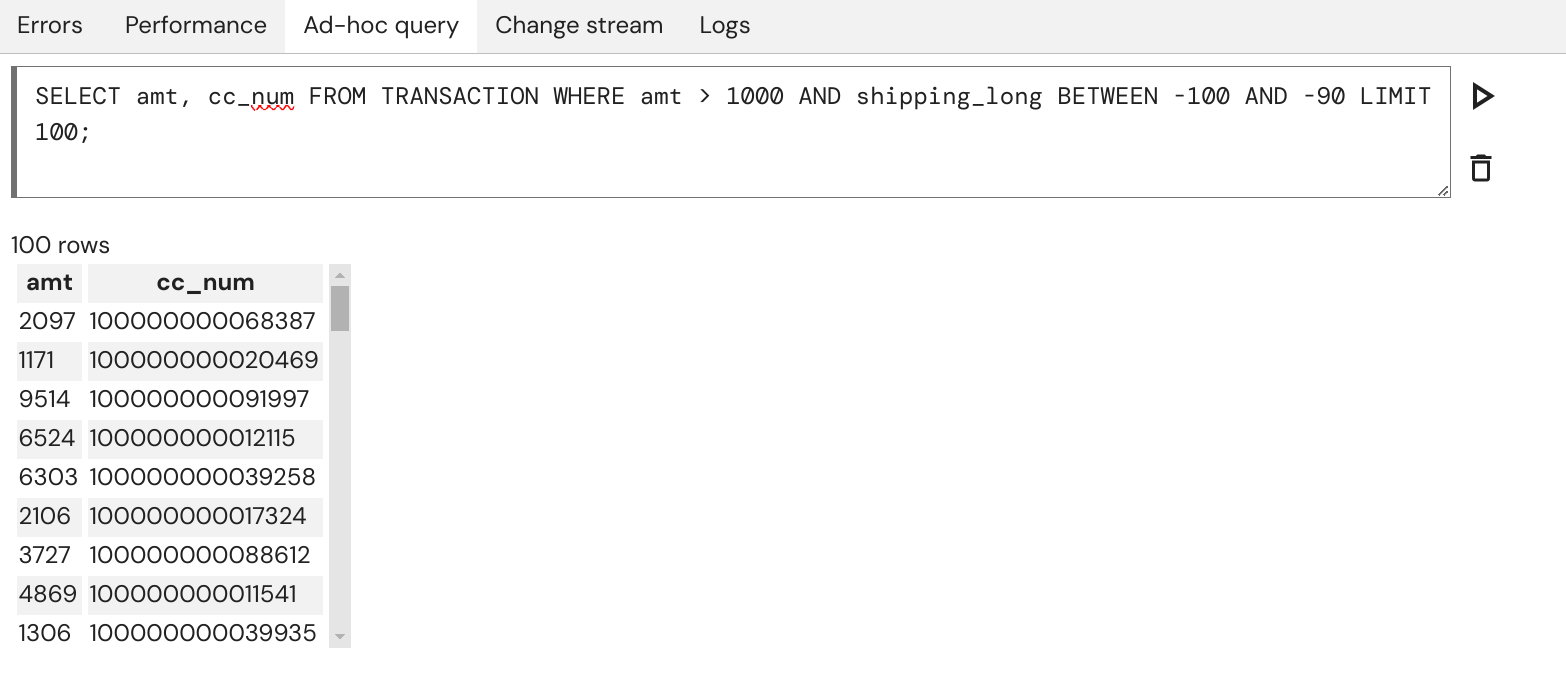
You can issue ad-hoc queries by opening the "Ad-hoc query" tab of the pipeline and typing a SQL SELECT or INSERT
query in the input text field. To submit the query, press Enter or the Play Shift + Enter. After successful execution of the query you will see a table
containing the results. You can abort a long-running query by clicking the Stop Ctrl + C.
Feldera CLI
fda exec pipeline-name "SELECT * FROM materialized_view;"
cat query.sql | fda exec pipeline-name -s
Alternatively, you can enter the fda shell command to open an interactive shell and execute queries.
fda shell pipeline-name
Refer to CLI docs for more details.
Feldera Python SDK
You can execute ad-hoc queries via the Python SDK using the .query method, which returns a generator of Python Dictionaries:
gen_obj = pipeline.query("SELECT * FROM materialized_view;")
output = list(gen_obj)
There are variations of the .query method that return response in different formats:
- .query_tabular
Returns a generator of
String. - .query_parquet Saves the output of this query to the parquet file.
For INSERT queries it is recommended to use the execute method:
pipeline.execute("INSERT INTO tbl VALUES(1, 2, 3);")
REST API
Consult the query endpoint reference to run ad-hoc queries directly through the API.
Architecture
Ad-hoc queries are evaluated using the Apache Datafusion SQL engine against a consistent snapshot of the pipeline's tables and views. This is achieved using a form of Multiversion concurrency control. The datafusion engine reads data directly from the pipeline's storage layer, which is shared with the Feldera SQL engine.
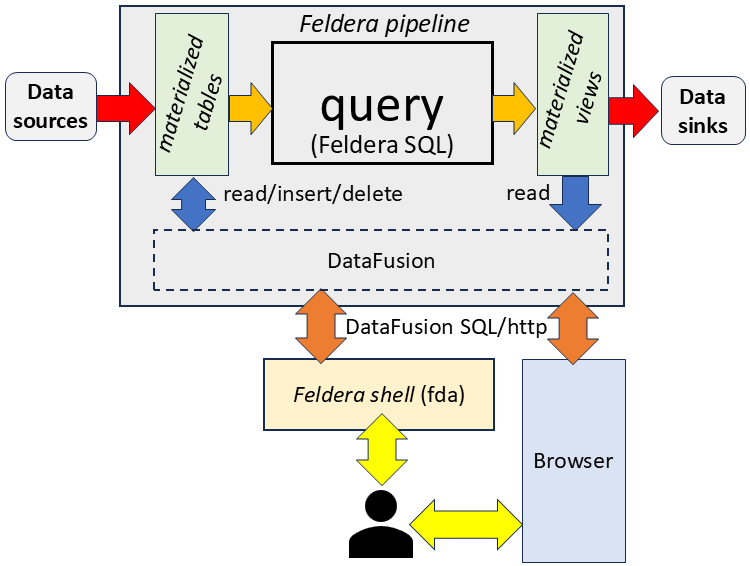
Ad-hoc queries can use CPU resources, memory and, to a lesser extent, storage (for intermediate results), especially if they are complex or involve scanning large datasets. Since these resources are shared with the Feldera SQL engine, such queries may reduce pipeline performance during ad-hoc query execution.
Read-after-write within a multi-statement ad-hoc query
A multi-statement ad-hoc request reads from a single consistent snapshot
captured at the start of the request. Intermediate INSERTs in the same
request are applied to the pipeline, but a trailing SELECT does not
observe them:
INSERT INTO t VALUES (1);
SELECT COUNT(*) FROM t;  -- returns the count before the INSERT
The same rule applies inside a user transaction: the request observes the state of all tables and materialized views as of the start of that transaction, even when earlier statements in the same request inserted into source tables.
Examples
Inserting Complex Data Types
Given the following Feldera SQL program:
CREATE TYPE struct_typ AS (
  a INT,
  b VARCHAR
);

CREATE TABLE complex_types (
    a INT ARRAY NOT NULL,
    b struct_typ NOT NULL,
    json VARIANT NOT NULL,
    m MAP<VARCHAR, INT>,
    tup ROW(one INT NOT NULL, two INT NOT NULL)
) WITH ('materialized' = 'true');
An ad-hoc query to insert data into the complex_types table would look like this:
INSERT INTO complex_types VALUES ([1,2,3], STRUCT(2, 'b'), '{"field": 3}', MAP(['answer'], [42]), STRUCT(2, 3));
Querying VARIANT Columns with JSON Functions
Datafusion currently has no equivalent of the Feldera SQL VARIANT type. An ad-hoc query
receives a VARIANT column as a string that holds the JSON-encoded value, so the Feldera SQL
subscript syntax (doc['name']) does not work in ad-hoc queries. Instead, ad-hoc queries
take JSON strings apart with the
datafusion-functions-json
function family. These functions can be used on any string column that can be decoded as
legal JSON.
| Function | Return type | Description |
|---|---|---|
json_get(json, path...) | union | Value at path; cast the result to select a concrete type (see below) |
json_get_str(json, path...) | VARCHAR | String value at path |
json_get_int(json, path...) | BIGINT | Integer value at path |
json_get_float(json, path...) | DOUBLE | Float value at path |
json_get_bool(json, path...) | BOOLEAN | Boolean value at path |
json_get_json(json, path...) | VARCHAR | Raw JSON text of the value at path |
json_get_array(json, path...) | array | Array at path, each element as raw JSON text |
json_as_text(json, path...) | VARCHAR | Value at path as text; also available as the ->> operator |
json_contains(json, path...) | BOOLEAN | Whether a value exists at path |
json_length(json, path...) | BIGINT | Length of the object or array at path |
json_object_keys(json, path...) | VARCHAR array | Keys of the object at path |
A path is a sequence of object keys and 0-based array indexes:
json_get_int(doc, 'scores', 0) reads element 0 of the array under the scores key.
A missing key, a mismatched type, or a NULL document yields NULL.
Given
CREATE TABLE json_docs (id INT, doc VARIANT) WITH ('materialized' = 'true');
where doc holds documents such as {"name": "Bob", "scores": [8, 10], "active": true},
the following ad-hoc query returns the names of active users whose first score exceeds 5:
SELECT id, json_get_str(doc, 'name') AS name
FROM json_docs
WHERE json_get_bool(doc, 'active') = TRUE
  AND json_get_int(doc, 'scores', 0) > 5;
json_get returns a value of a special union type. Prefer the typed getters
(json_get_int, ...) or cast the result to a concrete type, e.g.
json_get(doc, 'scores', 0)::BIGINT.
Parameterized Queries with PREPARE / EXECUTE
Ad-hoc requests accept a PREPARE statement followed by a single
EXECUTE that binds positional parameters ($1, $2, ...) to literal
values. The two statements must be submitted together in the same
request, separated by a semicolon:
prepare q AS SELECT * FROM materialized_view WHERE v = $1;
EXECUTE q('2');
Only the final EXECUTE produces the result set; the preceding
PREPARE is consumed during planning. Prepared statement names do not
persist across requests, and EXECUTE parameters must be literal
values.
See also
- Blog post on inspecting Feldera Pipelines.
- Tutorial using the Feldera Web Console to run ad-hoc queries.